

 7 mins read



The USD/JPY exchange rate is one of the most closely followed pairs in the global forex market. For traders in the UAE, understanding the factors that move the USD/JPY pair can help turn market insights into smarter trading decisions. This guide explains the key factors that influence USD/JPY and shows how UAE-based traders can approach the pair through position trading.
The USD/JPY currency pair is one of the most liquid in the forex market, consistently ranking among the top three by daily trading volume alongside EUR/USD and GBP/USD. UAE-based traders can access USD/JPY through forex brokers. TradeQuo offers 0 spread forex accounts and operates under UAE SCA regulation, providing local oversight for residents in Dubai, Abu Dhabi, and the wider UAE.
The USD/JPY currency pair tells you how many Japanese yen you need to buy one US dollar. If the exchange rate reads 160, it means 1 USD = 160 JPY. The US dollar is the base currency (the one you're buying or selling), while the yen acts as the quote currency (the one used to express the price).
What Is USD/JPY
The USDJPY pair is one of the most actively traded currency pairs in the world, sitting alongside EUR/USD and GBP/USD. For traders and investors in the UAE, this pair matters for several practical reasons. Many UAE portfolios hold US assets, meaning dollar strength or weakness directly affects rate.
Japan exports cars, electronics, and industrial goods into the Gulf region, so weaker JPY changes import economics. Beyond trade, USD/JPY functions as a risk barometer - it is the second-largest weighting in the US dollar index, proving its significance for anyone tracking the dollar. Understanding what moves USD/JPY week to week and over the long term is not a rocket science but also not for the newbies.
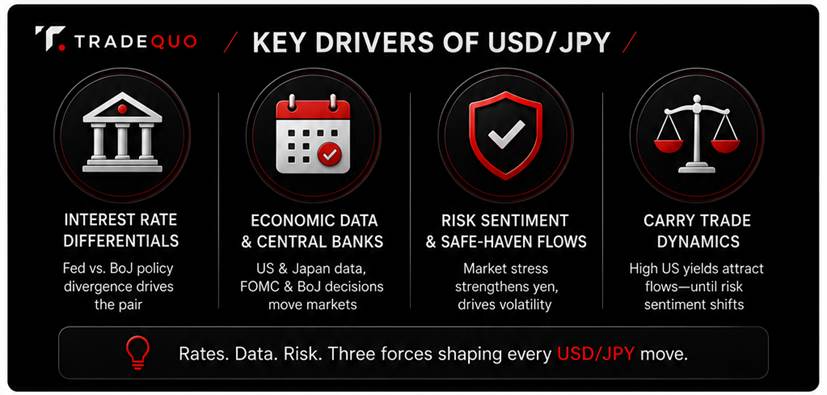
Economic data releases influence investor sentiment for USD/JPY regularly. From the US side, watch non-farm payrolls, CPI, PCE inflation, and FOMC meeting outcomes. From Japan, the Tankan business survey, Tokyo CPI, GDP, and wage data drive expectations.
Interest Rate Differentials, Carry Trade, and Market Sentiment
From 2022 onward, the wide spread between US and Japanese rates made USD/JPY one of the most popular carry trade pairs. UAE traders should track both interest rate expectations via central bank communication and risk sentiment through equity indices and volatility measures like the VIX. Understanding bear market vs bull market conditions can also help explain USD/JPY moves.
When markets are nervous, USD/JPY often falls. When traders feel more confident, USD/JPY can rise. UAE residents can access the USD/JPY market through forex trading.
USD/JPY trading is most active during major market announcements, and high liquidity in USD/JPY is present during US trading sessions as well as the Tokyo open. Position trading in this currency pair differs from short-term day trading: fewer trades, multi-week or multi-month horizons, and a focus on macro trends driven by monetary policy shifts rather than five-minute candles. Common trading hours run 24/5.
Position Trading with USD/JPY
Peak liquidity occurs during the Tokyo session (approximately 04:00–09:00 GST) and the London–New York overlap (approximately 11:00–17:00 GST). For UAE time zones, this means actionable windows both early morning and mid-afternoon. Position trading, however, does not require watching every market move throughout the day.
Trades may remain open for days or weeks, so traders can focus on the broader trend and check their positions when needed. In this case, the best trading app is something you need to open positions, set up price alerts, stop-loss and take-profit orders, and glance through important market updates. Position trading USD/JPY means combining a macro view - central bank policy direction, economic data trends - with basic technical analysis on daily and weekly charts.
Recommended framework:
- Use daily and 4-hour charts for entry timing; weekly charts for trend direction
- Identify trends with moving averages (50-day, 200-day) and trendlines
- Mark key support and resistance levels around recent highs, lows, and psychological levels (140, 150, 160)
- Limit risk to 1–2% of account equity per trade
- Place stop-loss orders beyond recent swing levels
- Set take-profit orders at levels offering at least a 1:2 risk-reward ratio
- Keep a simple trading journal: entry level, stop-loss, take profit, and outcome
Examples of Position-Trading Setups on USD/JPY
Scenario 1 - Fed signals higher interest rates
The Fed signals that US interest rates may stay high. USD/JPY then rises above an important price level, for example 155. A trader may buy USD/JPY after the price closes above 155.
They could place a stop-loss at 152 to limit the loss if the trade moves the wrong way, and set a target at 161. If the trader has a 10,000accountandwantstoriskonly1%(100), they would keep the trade size small enough that a move down to the stop-loss would lose about $100.
Scenario 2 - Bank of Japan raises interest rates
The Bank of Japan signals that interest rates may rise faster than expected. This can strengthen the yen and push USD/JPY lower. For example, if USD/JPY falls from 160 to 156, a trader may expect the decline to continue and trade for a further move toward 150. They can set a stop-loss above the current price to limit the potential loss if USD/JPY starts rising again.
Trading USD/JPY with TradeQuo
For UAE residents, TradeQuo offers a practical way to trade USD/JPY with regulatory backing. As an international broker, TradeQuo operates multiple regulated entities, including a firm licensed by the UAE SCA. Via TradeQuo you can have access to major forex pairs with competitive spreads, commission-free trading on the Standard plan, flexible base currency options (including USD and JPY), and minimum deposits starting from $1.
Zero spreads on major currency pairs offered by TradeQuo aim reduce trading costs over the long term. USD/JPY's high liquidity can mask significant volatility around news events, making deliberate risk management critical. This is not a pair where you can set positions and forget them.
Risk Management and Common Mistakes When Trading USD/JPY

Common mistakes by new UAE traders:
- Over-leveraging positions, especially around Fed meetings
- Ignoring the central bank calendar and getting caught by rate hikes or policy shifts
- Placing stops too tightly, leading to premature exits
- Trading emotionally - chasing breakouts or reacting to rumors
Define maximum leverage per trade and overall account exposure. For position traders, overnight and weekend risk matters: swap charges accumulate, and gaps can appear when markets reopen after events that has taken place during weekends.
Diversify across several forex pairs or asset classes instead of concentrating everything in one currency. Periodically review your strategy, adjust position sizes, and update risk limits. Disclaimer: This article does not constitute investment advice - always manage risk according to your own financial situation.
FAQs
What time of day is best to trade USD/JPY from Gulf Standard Time (GST)?
The most active periods coincide with Tokyo's opening hours (approximately 04:00–09:00 GST) and the London–New York overlap (approximately 11:00–17:00 GST).
Is USD/JPY suitable for beginners in the UAE?
USD/JPY's deep liquidity and tight spreads make it appealing, but the pair can move sharply on central bank news. New traders should start with a demo account, learn basic concepts like pips and lot sizes, and practice risk management before committing live capital.
How much leverage should I use when trading USD/JPY?
Conservative position traders often limit themselves to modest effective leverage - for example, 1:5 or less. If you want a refresher on how margin and exposure work, this leverage forex guide explains the mechanics before you calculate position size. Calculate your potential loss if the stop-loss is hit, and ensure it stays within 1–2% of your total account balance. Higher leverage increases the chance of losing money rapidly, particularly during volatile sessions.
Do I need to follow both the Federal Reserve and the Bank of Japan news?
Absolutely. The USDJPY pair reflects the relative outlook for US and Japanese monetary policy. Track FOMC meetings, BoJ policy decisions, inflation releases, non-farm payrolls, and key Japanese data like Tokyo CPI and the Tankan survey.