

 9 mins read


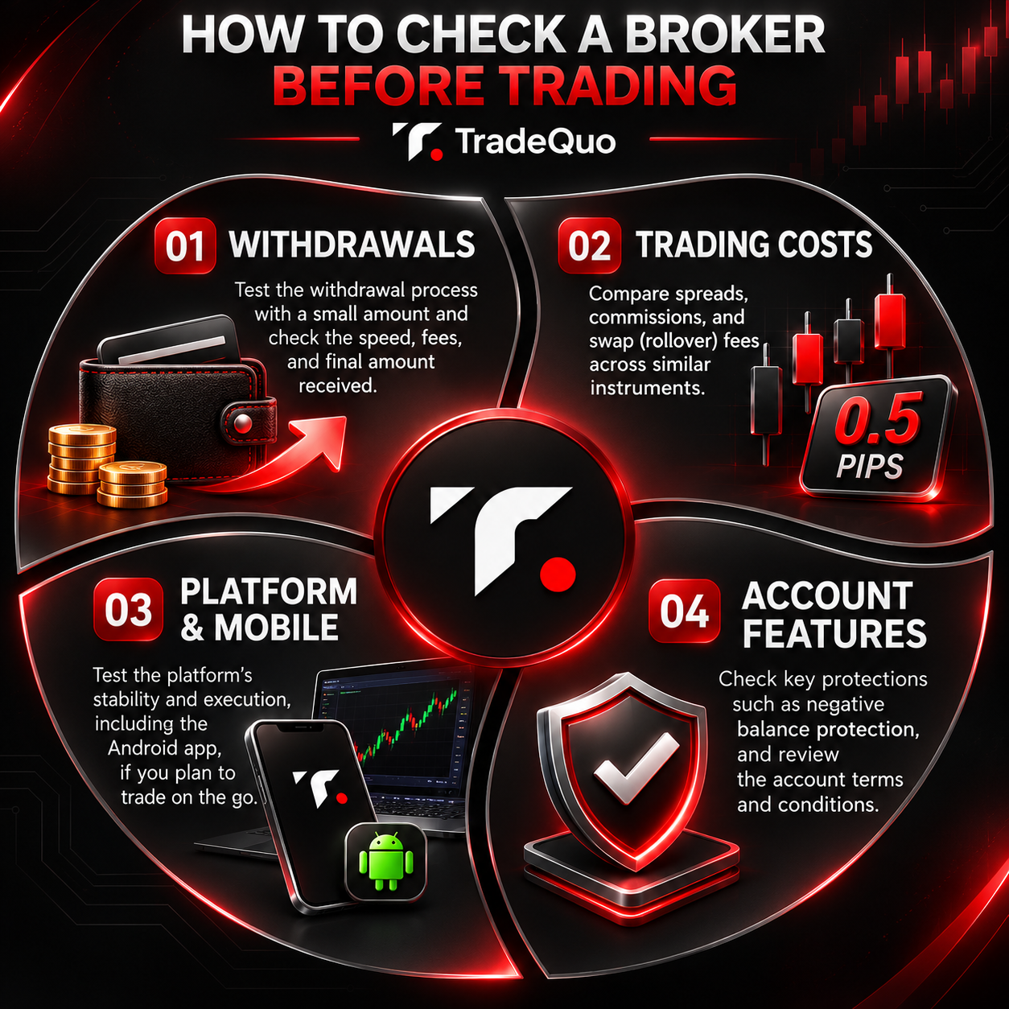
Choosing the wrong broker can cost you more than you might think. Before depositing funds into any account, you need to make sure that your broker is legitimate, fairly priced, and operationally sound. This guide walks you through exactly how to do that.
Key Takeaways
- Always confirm a forex broker’s regulatory license on the official register before making any deposit. No regulatory license is a major red flag.
- Test deposits and withdrawals with a small amount first, then review your bank statement for hidden fees or unexplained charges.
- Genuine broker performance means transparent execution stats, clear account types description, and responsive customer support.
- Segregated accounts, investor compensation schemes, and strict anti-money laundering controls are non-negotiable safety features.
Red Flags & License Check
Since the 2008–2009 financial crisis, the forex market has attracted both serious firms and outright scam brokers. Unrealistic profit promises like “guaranteed” 5% weekly returns ultimately attract much attention from those fresh in trading space. High-pressure sales tactics are common with scam brokers and should put you on alert immediately.
A trustable forex broker’s presentation or ad copy would be emphasizing transparent regulation and clear cost structures instead of unrealistic promises. Regulation is the non-negotiable first filter. Legitimate brokers display their registration numbers on their websites, and a broker’s regulatory status can be verified through official registries.
Find the license number and legal entity name on the broker’s website footer or legal page, not just on marketing banners. Check regulators: search the regulator’s public register using both firm name and number. Confirm the status reads “Authorized” or “Active,” not “Suspended” or “Revoked.”
Step 1: Confirm the Broker’s Legitimacy and Check AML Policy
Watch for clone firms. The AtlasFX Capital fraud used an FCA license number that belonged to a completely different broker, resulting in over $12 million in losses. If the legal entity name or domain doesn’t match the register entry, walk away-that’s a huge red flag.
Check which entity covers your account. Many brokers operate through multiple entities across jurisdictions. Make sure you know exactly which regulatory body oversees your specific account.
Client funds safety is a must. Regulated brokers must follow client money handling rules, and effective AML compliance is essential for licensed forex brokers. Failure to meet AML requirements can lead to significant fines, and brokers must file Suspicious Activity Reports for detected suspicious activities.
Step 2: Assess Client Funds Protection and Anti–Money Laundering Controls
- Segregated accounts protect client funds from the broker’s operating funds. Look for explicit statements and documents on the website.
- Compensation schemes protect client funds in case of broker insolvency. These don’t protect against trading losses, only broker failure.
- Verification is required before making deposits or withdrawals. A serious broker will request government-issued ID, proof of address (such as a utility bill), and source-of-funds documentation. Documents must match the account holder’s name exactly.
- A complete lack of AML policies: no request for ID, no bank statement verification, willingness to accept money from anyone-is a major red flag that may expose you to money laundering risk.
High-performing brokers use strict KYC and anti-money laundering procedures to combat money laundering. This might slightly slow first withdrawals, but significantly increases fund safety. A broker’s performance is reflected in its total cost of trading.
Hidden fees and unclear terms are red flags for scams. Find info on the broker’s average spreads and commissions to understand trading costs and compare account types. For example, a Standard account typically shows EUR/USD spreads of 1.0–1.5 pips or less with no commission.
Step 3: Evaluate Trading Conditions, Account Types, and Hidden Fees
- Compare account types: ECN/Raw accounts offer low spreads (often 0.0–0.3 pips) plus commissions of 3–7 per round-turn lot. Islamic (swap-free) accounts may substitute the charges.
- Check swap/rollover fees inside the trading platform. For overnight or long-term traders, these fees quietly erode returns and vary significantly between brokers.
- Hunt for non-trading fees: inactivity charges, conversion fees (some brokers may charge currency conversion fees on deposits), deposit/withdrawal surcharges, and bank wire fees that may only appear on your bank statement.
Transparent brokers publish clear tables of trading and funding costs. Vague or buried fee information is a potential hidden-fees red flag. Search for those positioning themselves as no-markup brokers, this way, it’s 90% that you won’t find unexpected surprises with costs of trading.
Step 4: Check Execution Quality and Real-World Trading Performance
Low latency and minimal slippage improve trading execution quality, and you can measure these yourself. High-performing brokers are typically comfortable showcasing their trading platform performance. Withdrawal issues often signal a scam broker, with a strong BUT: absolutely any broker in the public space would have those claims of being scam or withholding the funds, and most of those are produced by either the reviewing site itself, such as WikiFX or fetched by a competing broker with similar trading offer and features.
- Understand execution models. ECN brokers route orders to shared liquidity pools (raw spreads + commission). Market makers quote their own prices, which can create a conflict of interest. STP sits between the two.
- Look for published execution statistics: fill rates, positive vs negative slippage percentages, and average execution time in milliseconds.
- Test a broker’s platform using a demo account to assess performance during liquid sessions. Then open a small live account and run small trades around major economic news releases to see how spreads, slippage, and requotes behave under pressure. If you trade on android, test the mobile platform as well for stability, order entry, chart responsiveness, and account access.
- A pattern of consistent negative slippage, frequent requotes on normal volume, or repeated “off quotes” errors is a major red flag that the broker’s claims about execution quality don’t hold up in practice.
- Before depositing, make sure charts, order entry, and account functions work properly. If crypto is part of your strategy, pull up an instrument such as DOGUSDT or any other you plan to trade, and check its spread and contract size. If trading gold or oil outside the usual Monday-to-Friday schedule matters to you, check whether options such as GOLD247 are available.
Step 5: Scrutinize Deposits, Withdrawals, and Banking Transparency
The real test of any broker is whether you can get your money out as easily as you put it in. Reputable brokers clearly indicate that client funds are held at recognized banks, provide realistic withdrawal timelines, and do not change terms after you’ve funded your account. Evaluate customer support response time before depositing funds.
- Funding options often include bank transfer, bank wires, debit/credit cards, stable coins, and e-wallets. Each may have different processing times and fees.
- Withdrawals should return via the same way and in the same name as the trading account to comply with anti-money laundering rules. Withdrawal requests may take up to 5 business days to process, and brokers may impose fees for withdrawals below a certain threshold.
- Review the withdrawal policy carefully before funding: minimum amount, maximum limits, processing times, fees per payment method, and any bonus-related account restrictions.
- It may take up to 48 hours to verify a debit card, and brokers may block withdrawals until verification is complete. Verification processes can lead to delays in fund withdrawals.
- Run a test cycle: deposit a modest amount, place a few small trades, then request a withdrawal. Check your bank account or card ledger afterward-does the amount match? Are there unexplained charges?
- Red flags: forced additional deposits to “unlock” withdrawals, demands for more money to cover unrelated fees, repeated excuses, or unexplained delays beyond stated timeframes.
Reality bites, but in 2026, almost any broker can offer near-instant withdrawals. It mainly depends on whether they have invested heavily enough in the necessary infrastructure. As a client, you are free to choose a broker that offers fast withdrawal times — instant or near-instant, usually within 3–4 minutes.
Step 6: Test Customer Support, Disclosures, and Public Reputation
Professional support and clear documentation are part of a broker’s real-world performance.
- Contact support before depositing. Use live chat and email to ask specific questions about withdrawing funds, account types, and verification steps. Gauge responsiveness and clarity.
- Read the legal documents. Terms & Conditions, order execution policy, and client funds policy should be written in plain language. Key sections, including the legally required complaints procedure and dispute resolution path, should be easy to find.
- Check multiple sources: regulator disciplinary databases, online forums, and third-party review sites such as Trustpilot, Topbrokers, or Brokersview. Focus on patterns, especially repeated reports of unusual activity, frozen accounts, or altered trading conditions.
A few complaints are normal for any business. But consistent reports across multiple sources about the same issues-frozen client funds, ignored tickets, technical issues during withdrawals-are critical warning signs.
A Practical Pre-Deposit Checklist
- Verify the regulation and license number on the official regulatory body register.
- Confirm segregated client funds, bank partners, and any compensation scheme coverage.
- Review all account types, spreads, commissions, swap rates, and leverage caps.
- Confirm there are no unclear or buried hidden fees (check inactivity, conversion, and withdrawal charges).
- Open a demo account to test execution, then fund a small live account.
- Run a full deposit–trade–withdrawal cycle and compare your bank statement against expected amounts.
- Test customer support in writing before committing hard-earned money.
- Save email/chat transcripts and copies of key policies in a personal due diligence file.
Many traders start with USD 200–500, enough to cover a few small trades and meet most minimum withdrawal thresholds. On TradeQuo, you can start with $1. And remember: online reviews are one signal, but they can be manipulated.
FAQ
Can I trust a broker just because it has good online reviews?
No. Always cross-check reviews across multiple independent sources, prioritizing long-term feedback trends over isolated comments. A regulated broker with mediocre reviews often beats an unregulated one with glowing testimonials.
Is it safe if a forex broker only accepts crypto deposits?
Crypto-only funding with no clear regulatory license or bank relationship is a major red flag for both client fund safety and money-laundering risk. Reputable brokers in the forex trading industry accept traceable methods such as bank transfers, card payments, or regulated e-wallets and provide clear withdrawal channels back to the client’s bank account.
What documents should I expect to provide before I can withdraw?
Common KYC documents include a government-issued photo ID, proof of address (utility bill or recent bank statement), and more rarely proof of funding source.
How often should I re-evaluate my forex broker’s performance?
Review your broker’s performance at least every 6–12 months, or immediately after any change in spreads, leverage rules, or withdrawal conditions. Monitor ongoing execution quality, support responsiveness, and any changes in regulatory status.