

 8 mins read


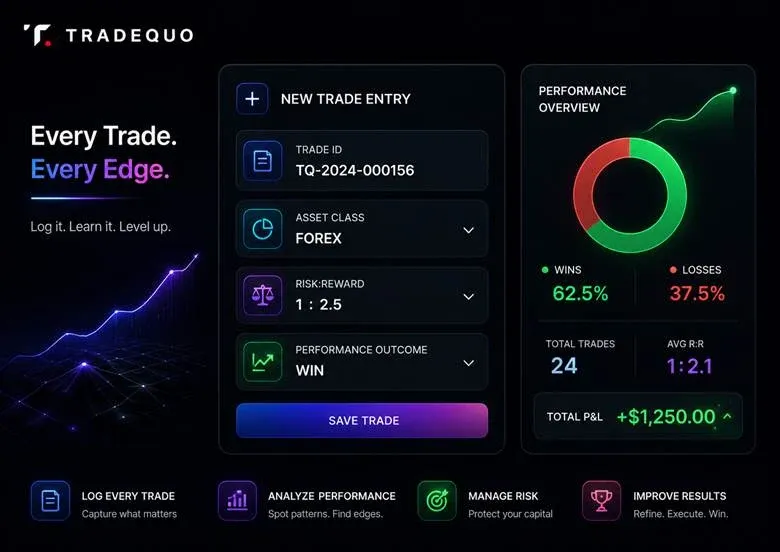
Most traders treat their trade history like a receipt drawer-stuffed full, rarely opened. But the minority who consistently profit in the forex market share one trading habit: they journal every trade, review it, and use the data to sharpen their edge. Serious forex traders use a forex trading journal as a structured feedback loop, not just a historical record, capturing market context, emotional state, and rule adherence alongside raw numbers.
A good trading journal goes beyond P/L to reveal patterns that raw MT5 statements cannot show. Reviewing performance metrics from TradeQuo's MT5 history must be consistent but simple. Track a core set of fields on every trade, then expand once the habit is solid.
By 2026, professional and prop forex traders almost universally journal their trades. Journaling is one of the most commonly shared traits. Most traders who lose funds rely only on broker statements or raw MT5 reports.
Why Serious Forex Traders Can't Skip a Trading Journal
Maintaining a trading journal helps traders bridge the gap between strategy and performance because it forces you to compare what you planned against what you actually did. Documentation of every trade helps monitor trading strategy performance across sessions, pairs, and market conditions. A forex journal is one of the few tools that levels the playing field between retail traders and institutional desks.
Institutions rely on data teams, feedback loops, and risk models. With a journal, you build your own. Trading journals serve as an objective, historical record for traders, capturing how you actually trade under pressure, not how you think you trade. By tagging trades by setup type, currency pair, trading session, and emotional state, you can identify patterns like: "EUR USD London breakout trades average +1.8R, while late NY scalps consistently lose money."
Journals help traders recognize strengths and weaknesses in their trading, separating strategy flaws (the edge is weak) from behavior flaws (revenge trading, moving stops, impulsive trades). Consistent journaling converts variance into long-term expectancy, revealing your real trading skills. A good trading journal has three layers: pre-trading plan, execution data, and post-trade review.
The Core Components of a Good Forex Trading Journal
Use a structured format to capture both technical details and personal thoughts. A comprehensive journal retains details of trades and market conditions. New traders should start with a lean template and add fields once they can maintain daily journaling for at least 30 days.
TradeQuo traders can build this structure on top of exported MT5 trade history, avoiding manual entry of every numeric field. Screenshots of the actual chart before entry and at exit are optional but highly recommended for visual learners. Capturing pre-trade data ensures your later analysis isn't compromised by hindsight bias.
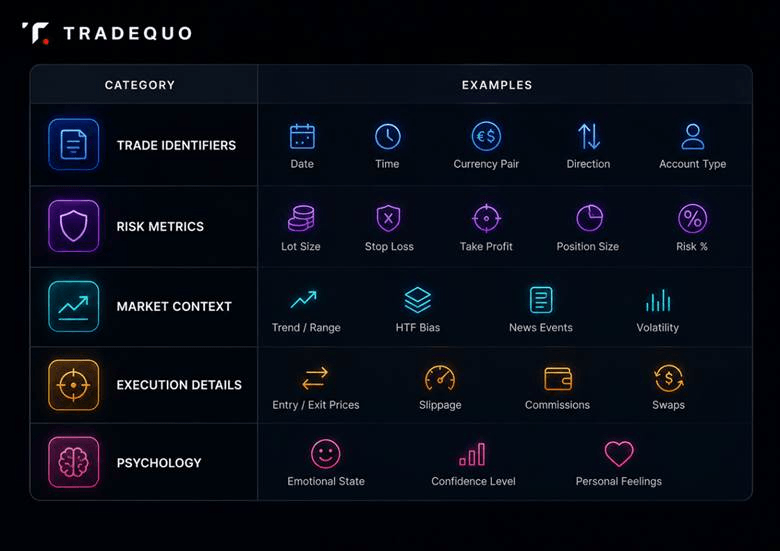
Before you enter, fill in these fields-ideally in a spreadsheet or simple form:
- Date and time: both UTC and local (e.g., "2026-07-03, 08:15 UTC"). Time matters because spread conditions and volatility shift across sessions.
- Instrument: track currency pair, entry, exit, and lot size. Specify the pair (EUR/USD, GBP/JPY, XAU/USD) and whether you're on a live or demo account.
- Direction: long or short.
- Market context: trend or range on the higher timeframe, such as "D1 uptrend, H1 pullback." Note upcoming news events (e.g., "NFP in 2h," "FOMC tomorrow") and volatility conditions (ATR, spread level). Include emotional state and market conditions in your journal entries.
- Session tag: record the trading session to identify performance patterns during Asian session, London session, New York session, or overlaps. Track specific metrics like session, pair, and lot size for forex trades.
- Setup type: define it in advance, breakout, pullback, mean reversion, news fade, range scalp. Without pre-defined labels, filtering by type later becomes impossible.
- Risk plan: planned entry price, stop loss, take profit, lot size, and pre-calculated risk in pips and account currency (e.g., "risk = 1.0R = $100 or 1%").
- Emotional state: rate yourself on a simple scale (1–5: calm, slightly tense, excited, fearful, tilted) plus a one-line note if anything unusual is happening-lack of sleep, recent big loss, outside stress.
- "Why this trade?": one or two lines capturing your thought process. Keep it specific and testable so you can review it later.
Post-trade notes should be written as soon as possible after closing. Journaling after the fact leads to forgotten details and emotions, so capture data while it's fresh.
What to Capture During and Immediately After Each Trade
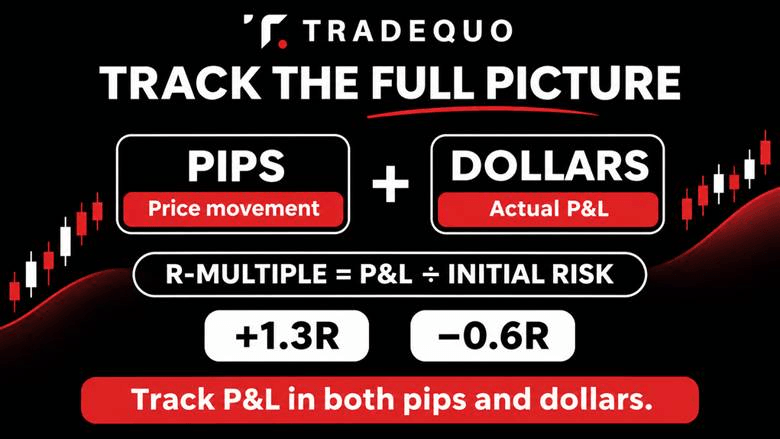
Execution details. Actual entry price, realized stop and target, any partial exits or scaling, and slippage relative to planned prices. Your exit price versus the planned target reveals execution quality.
Profit and Loss. Log final results in both pips and dollars. Only tracking P&L in pips ignores the real dollar impact, so track P&L in both pips and dollars for accurate analysis.
R-multiple. Result divided by initial risk (e.g., "+1.3R," "−0.6R"). This normalizes results across different position size levels for an apples-to-apples comparison.
Advanced Data: Risk, Performance Metrics, and Expectancy
Once foundational data is in place, serious forex traders look deeper with advanced analytics beyond simple win rate. They investigate the percentage of wins vs losses. Such tactic is applied because the win rate alone misleads if average wins are tiny and average losses are large.
Average win vs average loss. They are expressed in R-multiples. If your average win is 2R and average loss is 1R, you can profit even below a 50% win rate.
Profit factor. The gross profit is divided by gross losses. Above 1.5–2.0 is acceptable; above 3.0 is strong.
Market Context: Why It Matters More in Forex
The forex market is driven by macro events, interest-rate expectations, and session-based liquidity. This makes market context more important than in single-stock trading. For each trade, record:
- Dominant trend on D1/H4 and key support/resistance levels.
- Proximity to major economic releases (ECB rate decision, US CPI, NFP).
- Overall risk-on/risk-off mood and whether your trade aligns with the broader USD, EUR, or JPY narrative.
- Spread and liquidity conditions around entry-normal, wide, or extremely wide, particularly during session opens and news spikes.
Reviewing a trading journal regularly helps identify recurring mistakes. Log recording entry, exit prices, and P/L with context. That prevents you from grouping by session, setup, or emotions.
You can't identify patterns from flat data. Journaling only on good days, skipping losing streaks, or abandoning the journal after a busy month destroys the historical record. Best practices for journaling include consistency, honesty, and regular reviews.
Reviewing Your Trades: Daily and Weekly Cadence
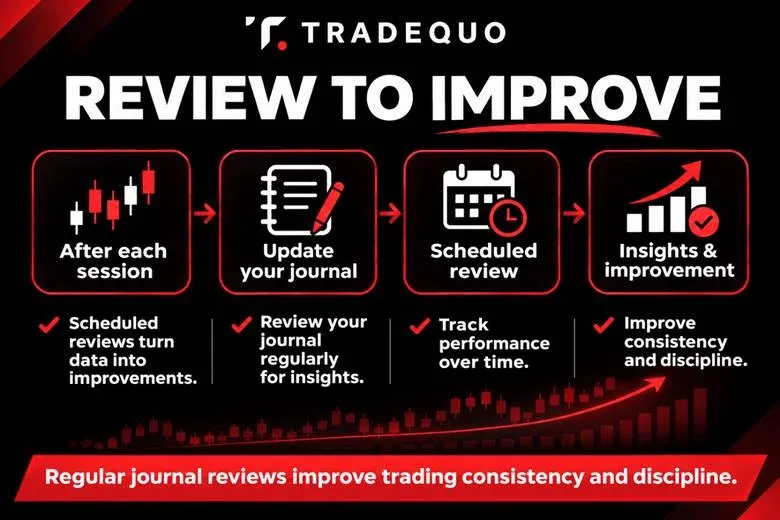
Recording trades is half the job. Scheduled reviews turn data into improvements. Regularly review your journal after each trading session for insights.
Trading journals help track performance over time, and regular journal reviews improve trading consistency and discipline. Active day traders scan the day's trades and mark plan adherence. This daily review keeps lessons learned fresh.
Weekly review (30–60 min). Filter past trades by setup and session, check win rate and R-multiples, and list the top 3 mistakes and top 3 strengths. This highlights areas that need immediate adjustment.
Position Sizing and Risk Management: What Your Journal Should Reveal
Even a winning strategy can ruin an account with poor position sizing, making risk management tracking non-negotiable. Log intended risk per trade (% of account), actual lot size, and realized R. Compare theoretical risk to what you actually did.
Review for patterns. Check for oversizing comfortable but mediocre setups. Such an imbalance often appears after a few dozen trades.
Failing to track correlated pairs increases hidden risk exposure. If you're long EUR/USD and long GBP/USD simultaneously, your effective position size may be double what you intended.
Conclusion: Turning Data Into Better Forex Decisions
Every serious trader needs a forex trading journal because memory and broker statements alone do not reflect patterns nor correct behavioral errors. A detailed record of both the numbers and the context behind them, market conditions, emotional state, plan adherence is what separates traders who improve performance from those who repeat the same mistakes for years. Export your last month of MT5 trades from TradeQuo today.
Build a simple forex journal around this data. Commit to journaling every position you open from now on. Start lean, review weekly, and let the data shape your trading decisions.
FAQ
How many trades do I need in my forex journal before the data is useful?
Patterns start to emerge after 30–50 trades in a single setup type, with more reliable statistics appearing after 100+ trades. Avoid making drastic strategy changes based on fewer than 20 trades-that's reacting to noise, not signal.
Do I need a separate forex journal for each strategy?
Use one master journal with a clear "Strategy/Setup" column so you can filter by strategy while still seeing overall account behavior and risk. Separate tabs or pivot tables are better than entirely separate files.
Is a digital journal better than a handwritten one for forex trading?
Both can work, but digital journals (spreadsheets or apps) integrate more easily with TradeQuo's MT5 exports, allow quick sorting and filtering.
How much time should I spend journaling each day?
Expect 1–2 minutes per trade to fill core fields, plus a 5–15-minute end-of-day review for active traders. The habit must be sustainable on busy days. Use TradeQuo's MT5 account history at day's end to verify entries and fill in any missing numbers, rather than trying to log everything mid-trade.
Should I journal demo trades or only live trades?
Demo trades are worth journaling when learning a new strategy, as they help refine rules and spot common mistakes before risking real capital. However, emotional state will differ between demo and live accounts. Fear, greed, and pressure scale with real funds.