

 7 mins read


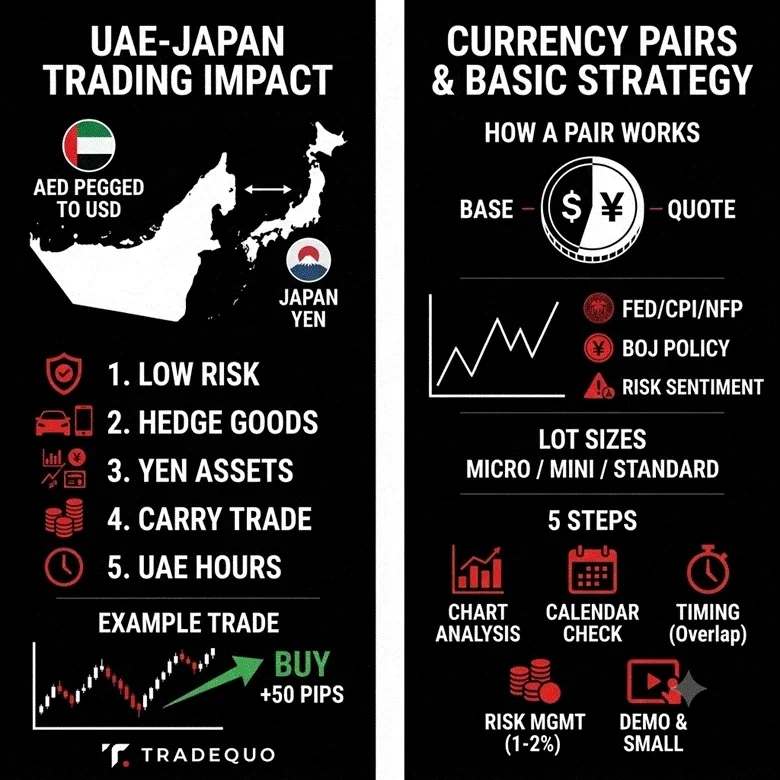
Most UAE-based traders blow up their first few trades for one boring reason: they never actually learned how currency pairs move. This guide uses USD/JPY to fix that-why this pair matters specifically if you're trading from the UAE, and what really pushes the dollar-yen exchange rate. USD/JPY is the second-most-traded currency pair globally, connecting the world's largest economy (the USA) with the third-largest economy (Japan).
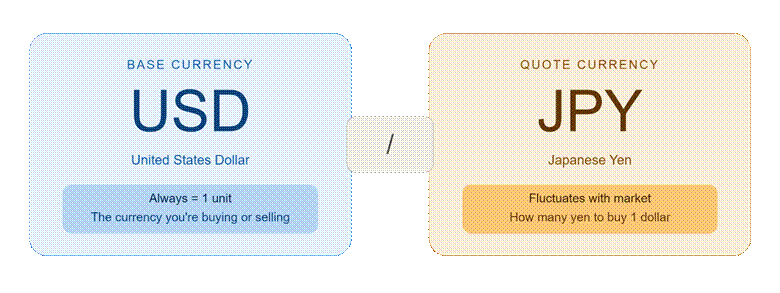
It offers high liquidity, tight spreads, and deep market participation-qualities that make it attractive for active forex traders in the UAE. The rate tells you how many Japanese yen one us dollar buys. When USD/JPY is 160.00, one U.S. dollar buys 160 Japanese yen.
Key Takeaways
Movements are driven mainly by the Federal Reserve and the Bank of Japan. The USD/JPY pair is popular for both short-term and long-term trading strategies, but beginners must understand leverage risk and use strict risk management before going live. All forex trading involves buying one currency while selling another.
These two currencies are always quoted together as a "currency pair." Currency pairs represent the value of one currency against another and consist of a base and a quote currency. Base currency is the first currency listed (the one you buy or sell).
Quote currency (also called the counter currency) is the second currency listed (what you pay or receive). Here is how to read common major pairs:
Pair | Base Currency | Quote Currency | Example Rate | Meaning |
EUR/USD | EUR | USD | 1.08 | 1 euro buys 1.08 dollars |
GBP/USD | GBP | USD | 1.25 | 1 pound buys 1.25 dollars |
USD/JPY | USD | JPY | 160.00 | 1 dollar buys 160 yen |
Approximately half of all forex trades involve the US dollar.
Quick example trade:
- You see EUR USD at 1.0800 and believe the euro will strengthen.
- You buy 0.10 lots (10,000 EUR).
- Price rises to 1.0850, you close for a 50-pip profit.
Major currency pairs (EUR/USD, USD/JPY, GBP/USD, USD/CHF) generally offer high liquidity and tighter spreads. Minor pairs exclude the dollar (e.g., EUR/GBP), and exotic pairs involve emerging-market currencies like USD/TRY, with wider spreads and higher risk. USD/JPY sits alongside EUR/USD as one of the most heavily traded currency pairs in the forex market.
EUR/USD is the most traded currency pair globally; USD/JPY is the second. The USD/JPY pair shows how many yen are needed for one dollar. When the rate rises from 155.00 to 160.00, the dollar has strengthened, and the yen has weakened.
How the USD/JPY Currency Pair Works
In 2022, the yen fell to a 24-year low against the dollar, with USD/JPY pushing above 150 for the first time in decades. More recently, in 2026, the pair has traded between roughly 152 and 162, illustrating continued dollar strength. For pips: JPY pairs are typically quoted to two decimal places.
A move from 160.00 to 160.01 equals one pip. USD/JPY is one of the most liquid currency pairs in forex, with the most trading volume during the Tokyo, London, and New York sessions, often resulting in tight spreads and fast execution. The UAE dirham has been pegged to the US dollar at approximately 3.6725 AED per US dollar since the late 1990s. This means USD price action directly translates to AED value.
When USD/JPY rises 3%, AED/JPY rises roughly the same amount. The USD/JPY exchange rate is significant for traders in the UAE for several concrete reasons:
- Hedging Japanese imports: UAE businesses importing Japanese vehicles, electronics, or machinery can use USD/JPY to hedge risks associated with international trade involving Japanese goods.
- Investment exposure: traders holding assets denominated in yen-Japanese equities or bonds-need to monitor this pair closely.
- Carry trades: UAE traders often utilize the yen for carry trades, borrowing in yen (with its low domestic interest rates) to invest in higher-yielding dollar assets.
- Speculation: Betting on central bank policy divergence between the Federal Reserve and the Bank of Japan remains a core strategy.
UAE trading hours (GMT+4) overlap with the late Tokyo session in the morning and the London open in the early afternoon, giving local traders access to active USD/JPY price action during regular business hours.
Key Drivers of the USD/JPY Exchange Rate
USD/JPY is heavily influenced by interest rate differentials, central bank policy, and global risk sentiment, not just short-term economic news. Higher interest rates from the Fed attract capital into dollar assets, pushing USD/JPY higher. When US rates sat above 5% while Japan remained near 0%, USD/JPY pushed toward multi-decade highs.
Key economic data-CPI inflation, non-farm payrolls, and GDP-can trigger sharp moves. Interest rate shifts can produce substantial moves in USD/JPY. The BoJ (Bank of Japan) maintained ultra-low or negative rates for years. Recent monetary policy shifts suggest rates could approach 0.75–1.00% by late 2026, but the interest rate gap with the US remains wide.
Japan's Ministry of Finance has intervened in the foreign exchange market when USD/JPY breaches certain thresholds, spending an estimated ¥9.5–10 trillion during Golden Week 2026. BoJ announcements cause sharp price action because the market is heavily influenced by any signal of raising interest rates. The Japanese yen is considered a safe-haven currency, almost like gold reserve.
Risk sentiment and safe-haven dynamics:
- Traders typically sell USD/JPY to buy yen during periods of economic uncertainty, and the yen often strengthens during periods of market stress.
- Movements in USD/JPY are based on shifts in global risk appetite-when risk appetite increases, carry trades push USD/JPY higher; when it drops, the yen strengthens.
- USD/JPY is correlated with other safe-haven assets like the Swiss franc and serves as a key indicator of global market sentiment.
Compared to EUR/USD or GBP/USD, the USD/JPY pair often reacts more strongly to bond yields and central bank surprises than to minor economic events. Forex trading is typically done through CFD on a trading platform. You speculate on market price movements in pair.
USD/JPY quote: 160.00 (bid price) / 160.02 (ask price). The 0.02 spread is your cost to open.
Lot Type | Units | USD/JPY at 160.00 = JPY Exposure |
Standard | 100,000 | 16,000,000 JPY |
Mini | 10,000 | 1,600,000 JPY |
Micro | 1,000 | 160,000 JPY |
How Currency Pairs Are Quoted and Traded in Practice
Leverage lets you control a larger position with a smaller deposit. For example, at 1:100 leverage, a 1,000 USD margin controls 100,000 USD. Higher leverage magnifies both profits and losses.
Hypothetical USD/JPY trade:
- Buy 0.10 lots at 160.00 → controlling 10,000 USD (1,600,000 JPY exposure).
- Set stop-loss at 158.00 and take-profit at 164.00.
- If take-profit hits: profit = (164.00 − 160.00) × 10,000 = 40,000 JPY.
- If stop-loss hits: loss = (160.00 − 158.00) × 10,000 = 20,000 JPY.
Always attach stop-loss orders. Understanding currency pairs means understanding that losses can happen quickly.
Beginners in the UAE can approach USD/JPY systematically. Start with these building blocks:
- Technical analysis basics: use horizontal support and resistance at key levels (e.g., 152–155 support, 160–161 resistance in 2026), trendlines, and a 50-period or 200-period moving average to identify market trends.
- Economic calendar: track Federal Reserve and Bank of Japan meetings, US CPI, NFP, and major Japanese economic data. Avoid opening positions right before high-impact releases.
- Session timing: focus on the late Tokyo session (UAE morning) and the London open (UAE early afternoon) for higher yields in terms of liquidity and price action.
- Risk management: risk only 1–2% of account equity per trade. Always use stop-loss orders. Understand that leverage can quickly magnify losses under volatile market conditions.
Traders looking to start trading USD/JPY and other major pairs can explore TradeQuo's Standard Account, but each trader must review current conditions, spreads, regional restrictions, and full risk disclosures before committing capital.
FAQ
Is USD/JPY a good currency pair for complete beginners in the UAE?
The financial stability of your trading account depends on disciplined habits, not just the pair you choose.USD/JPY is highly liquid, with tight spreads and plenty of market analysis. However, it can be volatile during major economic events, so beginners should start with a demo account and small position sizes.
How does the AED–USD peg affect my USD/JPY trades?
The AED’s peg to the USD helps reduce currency conversion fluctuations, but it does not eliminate trading risk. USD/JPY can still experience significant price swings driven by yen movements.
When is USD/JPY usually most active during the UAE trading day?
The pair is typically most active during the Tokyo session (around 4–10 AM UAE time) and the London–New York overlap (afternoon UAE time), when liquidity and volatility are highest.
What economic data should I watch if I mainly trade USD/JPY?
Focus on US Non-Farm Payrolls, CPI, GDP, and FOMC decisions, along with Bank of Japan meetings, inflation data, and the Tankan survey. These events often trigger strong price movements.
Do I need to follow other currency pairs if I only trade USD/JPY?
It’s helpful. Watching pairs like EUR/USD, GBP/USD, and USD/CHF can provide insight into overall US dollar strength, while bond yields and stock markets offer additional market context.