

 8 mins read


Forex Market Sentiment Explained: How to Use Trader Positioning as a Trading Signal
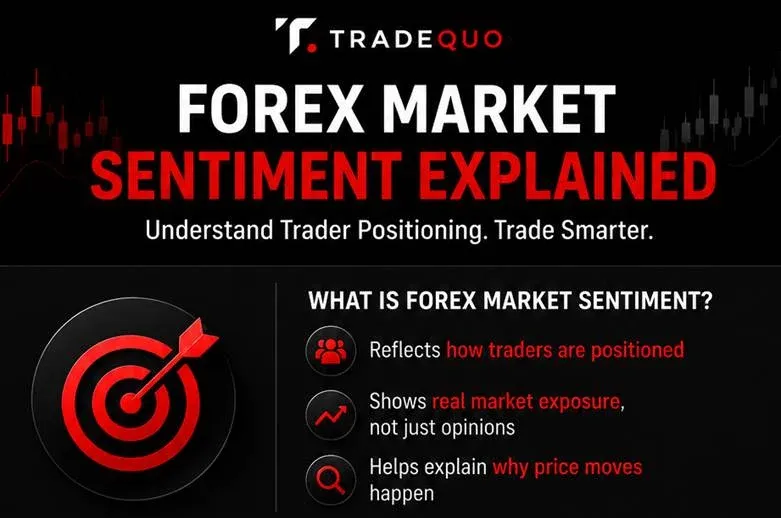
Price charts tell you what the market is doing, but they don't always explain why. Forex market sentiment reveals how traders are positioned, where the crowd is leaning, and whether a trend still has room to run or may be approaching exhaustion. No sentiment indicator can predict the future with certainty.
However, understanding trader positioning gives you valuable context that technical indicators or economic news alone cannot provide. When combined with price action and fundamental analysis, sentiment can help you spot higher-probability trading opportunities and avoid overcrowded trades. In this guide, you'll learn how retail and institutional positioning differ, where to find reliable sentiment data, and how to incorporate it into your trading strategy on TradeQuo.
Forex market sentiment reflects how traders are positioned and how they collectively view a currency pair. Retail positioning is often used as an indicator. Sentiment should complement, not replace, technical and fundamental analysis.
What Is Forex Market Sentiment And Trader Positioning?
Forex market sentiment describes the overall attitude of traders toward a currency pair. Rather than focusing on economic reports or chart patterns alone, sentiment measures where traders have actually committed their money through open long and short positions. This distinction is important.
Opinions expressed in social media posts, or market analyst forecasts can influence expectations, but open positions reflect real market exposure. Positioning data shows where participants have placed capital, making it a far more useful tool for understanding market behavior. Sentiment also helps explain why prices sometimes move against seemingly positive or negative economic news.
Markets don't react only to the news itself - they react to whether the outcome differs from what traders already expected and priced in. For example, a stronger-than-expected inflation report may fail to lift a currency if most traders were already heavily positioned for that outcome. Likewise, even a modest surprise can trigger a sharp reversal when positioning becomes excessively one-sided.
Where Does Trader Positioning Data Come From?
Several sources provide insight into market positioning, each reflecting a different group of participants. Many forex brokers publish aggregated client positioning data showing the percentage of traders holding long and short positions on major currency pairs. This information updates frequently throughout the trading day and offers a snapshot of retail behavior.
Retail sentiment is widely followed because individual traders often react emotionally during strong market moves, creating opportunities when positioning becomes extreme. Published weekly by the U.S. Commodity Futures Trading Commission (CFTC), the Commitment of Traders report provides positioning data from the futures market. The report divides participants into several categories, including:
- Commercial hedgers
- Non-commercial traders (large speculators such as hedge funds and asset managers)
- Non-reportable traders
Forex traders typically focus on non-commercial positioning because these participants often reflect institutional directional views over the medium to long term. Unlike retail positioning, the COT report is more helpful for swing and position traders. Professional traders also monitor implied volatility and options positioning to gauge broader market expectations.
Options and Volatility Markets
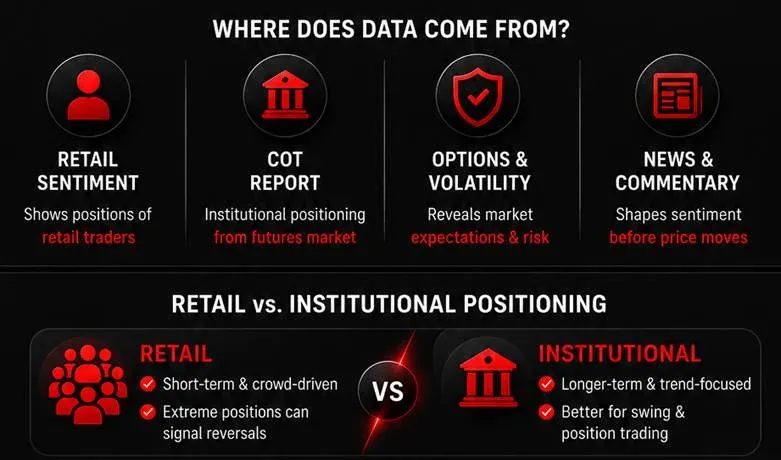
Indicators such as the VIX don't measure forex sentiment directly, but they can provide useful insight into overall market risk appetite. Rising volatility often coincides with increased demand for traditional currencies such as the U.S. dollar, Japanese yen, and Swiss franc. Financial news remains another valuable source of sentiment.
Central bank speeches, geopolitical developments, inflation reports, and employment data all shape expectations long before they influence prices. Monitoring the tone of market commentary alongside positioning data helps traders understand whether sentiment is strengthening or beginning to shift. Although both measure market positioning, retail and institutional data serve different purposes.
Retail positioning reflects how individual traders are currently positioned. Institutional positioning reveals how larger market participants are building longer-term exposure. This difference makes each source useful in different trading situations.
Retail Sentiment & Institutional Positioning
Retail positioning often becomes heavily concentrated after markets have already made significant moves. Many experienced traders view these extremes as potential signals. When an overwhelming majority of retail traders hold positions in one direction, it may suggest the trend is becoming crowded and vulnerable to a reversal.
That doesn't mean every extreme immediately leads to a price reversal. Strong trends can remain one-sided for extended periods. Institutional participants generally have longer investment horizons and greater market influence.
Many traders use it to confirm broader trends. For example, if non-commercial traders have steadily increased long positions in euro futures over several weeks while EUR/USD continues making higher highs, institutional positioning supports the existing trend rather than contradicting it. The weekly nature of the COT report also makes it more appropriate for identifying market bias than timing precise entries.
Why Market Sentiment Matters
Most traders concentrate on charts and economic calendars. Sentiment adds another dimension by revealing how much of a market move may already be priced in. Consider two identical economic reports released months apart.
The first creates a major rally and second barely moves the market. Why? Often, the difference lies in positioning.
If traders are already overwhelmingly bullish before the announcement, there may be few buyers left to push prices significantly higher. Conversely, if expectations are relatively balanced, even a modest surprise can trigger substantial movement. This relationship between expectations and positioning explains why markets sometimes react in unexpected ways.
Reading Retail Sentiment Correctly
Retail sentiment is one of the easiest positioning tools to access, but it should never be interpreted in isolation. Imagine a broker reports:
- 78% Long EUR/USD
- 22% Short EUR/USD
Some traders would immediately view this as a bearish signal.
That approach is too simplistic. Instead, combine positioning with market structure. Ask questions such as:
- Is the price approaching major resistance?
- Is momentum slowing?
- Are bearish reversal patterns forming?
- Is major economic announcement approaching?
When technical evidence supports the sentiment reading, the probability of a successful trade generally improves.
The opposite also applies. If retail traders remain heavily short during a strong uptrend supported by improving fundamentals, attempting to trade against the trend simply because sentiment is extreme can become expensive. Sentiment identifies potential opportunities.
Why Traders Use Retail Sentiment as Indicator
Retail positioning became popular because many regulated CFD brokers publicly disclose the percentage of losing client accounts. Across the industry, these figures commonly range between 70% and 90%, depending on the broker and reporting period. This doesn't mean retail traders are always wrong.
Instead, it suggests that when positioning reaches unusually high concentrations, such as 75–80% of traders on one side of the market, it deserves closer attention. Experienced traders often use these extremes as alerts. The goal is to identify situations where market positioning appears stretched and then wait for technical confirmation to make more informed trading decisions.
The strongest forex setups usually combine three forms of analysis:
- Fundamental analysis explains why a currency may strengthen or weaken.
- Technical analysis identifies key price levels and entry points.
- Sentiment analysis shows how traders are positioned.
For example, if institutional traders are increasing long USD exposure, and USD/JPY remains above key moving averages, the overall picture supports buying pullbacks. A simple process can help you integrate sentiment into your daily routine.
How To Trade Forex Sentiment Effectively On TradeQuo
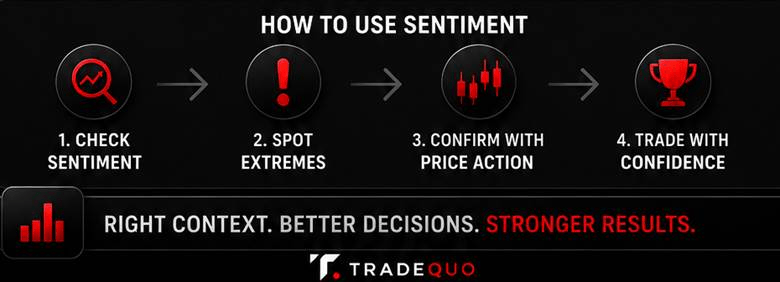
Review retail sentiment data and identify pairs with unusually one-sided positioning. Look for readings above 70–75% long or short. Identify:
- Trend direction
- Support and resistance
- Moving averages
- RSI or momentum conditions
Avoid trading sentiment without chart confirmation. Check:
- Central bank expectations
- Inflation data
- Employment reports
- Upcoming economic events
Major news releases can quickly change market sentiment.
If institutional positioning aligns with a strong trend and supportive fundamentals, trend-following opportunities may offer better risk-reward. Traders can practice integrating sentiment on a TradeQuo demo account, testing trend-following strategies with virtual funds before committing real capital. Use TradeQuo's blog and analytics resources alongside sentiment-based approach to continually improve trading discipline and execution.
Trend-Following Approach & Risk Management
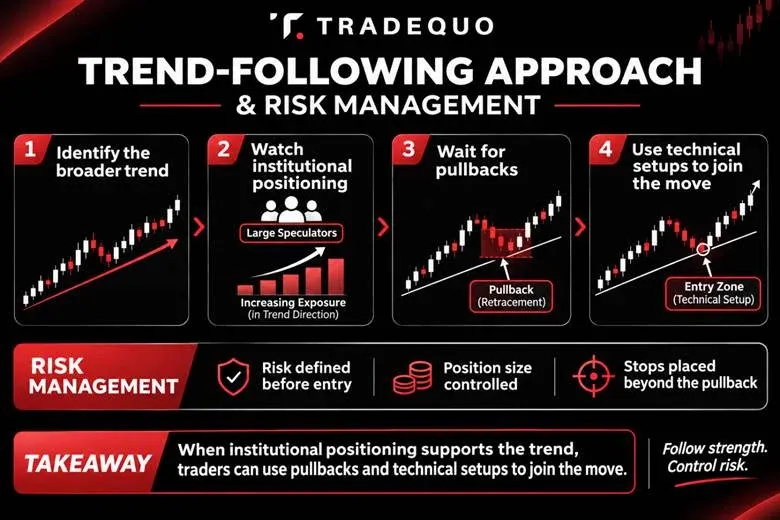
Institutional positioning is often more useful for trend traders. When large speculators continue increasing exposure in the same direction as the broader trend, traders can use pullbacks and technical setups to join the move. Because COT data updates weekly, it can be used to establish market bias.
Sentiment is a valuable tool, but it is not a guarantee. Follow basic risk-management principles:
- Risk only a small percentage of capital per trade.
- Use stop-loss orders based on market structure.
- Avoid oversized positions.
- Be cautious before major economic releases.
- Never trade solely because sentiment is extreme.
Good risk management matters more than any sentiment signal.
Positioning data does not tell you exactly when the price will move. Always seek technical confirmation. Markets can remain heavily one-sided for days or weeks.
Common Mistakes
Wait for evidence that momentum is changing. A strong sentiment setup can fail instantly when major news surprises the market. Weekly COT data is suitable for swing trading.
Intraday sentiment data is more useful for shorter-term trades. Match your sentiment source to your trading horizon. Forex market sentiment provides valuable insight into how traders are positioned.
Retail positioning can help identify crowded trades and possible reversals, while institutional positioning offers a broader view of market trends. Neither should be used in isolation. The most effective approach combines sentiment with technical and fundamental analysis.
Conclusion
When traders gain a clearer picture of market conditions, they can make more informed decisions. Used correctly, sentiment is a way to better understand market behavior, improve timing, and avoid following the crowd at the worst possible moment. But it should never be seen as 100% guarantee prediction tool.
Retail sentiment becomes most useful when positioning reaches extreme levels, and price action supports a potential reversal. Moderate imbalances often have little predictive value. The COT report is published weekly and is best suited for swing and position traders.
It can be used to establish market bias. But sentiment should complement technical and fundamental analysis. It helps identify opportunities but does not provide precise entry or exit signals.