

 11 mins read


Before any forex trade, UAE traders must run four core calculations: pip value, position size, margin required, and projected profit or loss. Skip any one of these, and you are guessing with your capital instead of managing it. Pip value, position size, margin required, and projected profit or loss control risk per trade, protect your trading account from market volatility, and reduce the need for constant market monitoring.
Mastering these calculations is crucial whether you prefer day trading, swing trading, or tracking medium-term trends in the foreign exchange market. Many UAE traders in Dubai and Abu Dhabi jump into forex trading on EUR/USD or other major currency pairs without running a single number. They pick a direction, choose a lot size, and hope for the best.
The result is often oversized losses that could have been avoided in under sixty seconds of simple arithmetic. These four calculations turn a vague trading idea into a quantified trading plan where risk, margin, and potential profit are all known before you click "Buy" or "Sell." The foreign exchange market is the largest financial market in the world, and price movements can be swift.
1. Pip Value: Know Exactly What Each Price Move Is Worth
Without knowing your numbers, even a winning trade can damage your account if the position is too large or the margin too thin. Pip value is the smallest price change a currency pair can make and the starting point for every money-related calculation in currency trading. A pip is typically 0.0001.
Prices in forex quotes can be offered up to five decimals (the fifth decimal is called a pipette), but the standard pip remains at the fourth decimal for most forex pairs. The base currency is the first currency in a forex pair. For EUR/USD, EUR is the base and USD is the quote.
Pip values differ based on the counter-currency in the pairing. Calculating pip value helps determine profit or loss per movement and is essential for understanding risk on a trade. Pip Value = Lot Size × 0.0001.
EUR/USD at 1.0800 - Pip values in AED:
- Standard lot (100,000 units): 100,000 × 0.0001 = USD 10.00 per pip → AED 36.73 per pip.
- Mini lot (10,000 units): 10,000 × 0.0001 = USD 1.00 per pip → AED 3.67 per pip. A pip is worth $1 for a 10,000-lot, confirming this number.
- Micro lot (1,000 units): 1,000 × 0.0001 = USD 0.10 per pip → AED 0.37 per pip.
To see how this scales practically, a 50-pip gain in a micro-lot equals $5 profit, or roughly AED 18.36. The same logic applies to GBP/USD or any pair where USD is the quote currency. When the quote currency is not USD (for example, USD/JPY or EUR/GBP), you first calculate the pip value in the quote currency, then convert it into USD and finally into AED.
Always verify the pip value shown on the broker's platform against your manual math. Also remember: the spread is the difference between buying and selling prices. It represents an immediate cost measured in pips, so knowing your pip value in AED lets you see exactly how much that spread costs you on every trade.
2. Position Size: Match Trade Volume to Your Risk Per Trade
Position sizing is the most critical calculation for risk management in volatile forex pairs. It connects your account balance, pip value, stop-loss distance, and risk percentage into a single number that tells you exactly how many lots to trade. Position sizing determines how much to buy or sell based on account size, ensuring you do not risk more than a safe percentage of capital.
Risk management strategies help mitigate potential trading losses, and this is where they start. Position Size (lots) = Risk Amount in AED ÷ (Stop-Loss in Pips × Pip Value per Lot in AED). Let’s imagine the account balance is AED 20,000 and risk per trade is not more than 1% (200 AED).
We are trading EUR/USD at 1.0800 with stop-loss of 30 pips. A good margin of error for a tight day trade stop-loss often sits around 15–20 pips, but 30 pips give room for noise on the EUR USD pair.
Day trade with a 30-pip stop:
- Pip value per standard lot in AED: AED 36.73
- Position size = 200 ÷ (30 × 36.73) = 200 ÷ 1,101.90 ≈ 0.18 standard lots
That is roughly 18,000 units, or about 1.8 mini lots, or 18 micro lots.
Stop-loss orders cap risk by exiting positions at set rates, so your maximum loss is pre-defined at AED 200. Now let’s take a look at what happens if we try to swing trade this position with an 80-pip stop. Stop loss is wider for swing trading to respect support and resistance levels.
Position size = 200 ÷ (80 × 36.73) = 200 ÷ 2,938.40 ≈ 0.068 lots. That is roughly 6,800 units. The trade size shrinks to keep risk constant despite the wider stop.
3. Margin Required: Check How Much of Your AED Capital Is Locked
Discipline is what separates experienced traders from those losing funds rapidly. Traders often use position size calculators to automate calculations, and TradeQuo's MT5 includes lot-size fields that support fractional entries (e.g., 0.01 lots). Margin requirement is the capital needed to open and maintain a leveraged position.
Many new traders in the UAE ignore this number and end up over-leveraged when market volatility spikes, triggering margin calls that force positions to be closed at the worst possible time. Understanding how leverage works is essential because it amplifies buying power in trading - but it equally amplifies losses. Margin = (Position Size × Market Price) / Leverage.
The margin formula is straightforward. Margin equals position size multiplied by market price, divided by leverage. For an AED-funded account, convert the USD into AED at 3.6725.
Example 1 - Medium position (0.50 lots EUR/USD):
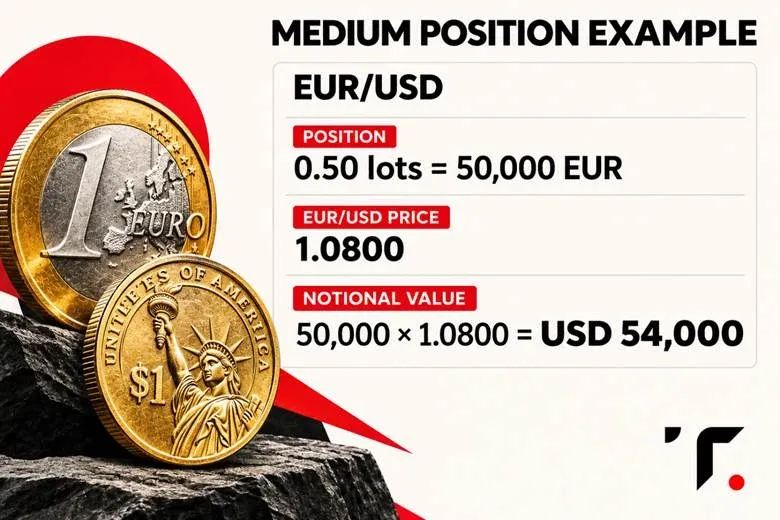
- Position: 0.50 lots = 50,000 EUR
- EUR/USD price: 1.0800 → Notional in USD = 50,000 × 1.0800 = USD 54,000
- Convert to AED: 54,000 × 3.6725 = AED 198,315
- Leverage: 1:30
- Margin required = 198,315 ÷ 30 = AED 6,610.50
- Free margin remaining (on AED 20,000 account) = AED 13,389.50
That single trade locks up about 33% of the account. Opening a second position of similar size would stretch the account dangerously thin. Now let’s take a look at the beginner position or 0.05 lots.
Position: 0.05 lots = 5,000 EUR. Notional USD = 5,000 × 1.0800 = USD 5,400. AED value = 5,400 × 3.6725 = AED 19,831.
Margin required at 1:30 = 19,831 ÷ 30 ≈ AED 661. Why it matters?
This leaves AED 19,339 of free margin - far more conservative and suitable for beginner traders building trading experience. Complex instruments like leveraged forex demand respect for margin limits. Before placing any trade on TradeQuo's MT5, check the margin preview in the new-order window.
It will display the required margin in your account currency. Verify that your free margin can absorb both the new trade and any unrealized losses on existing positions. If the free margin drops below the broker's stop-out level, positions will be automatically closed - often at a steep loss.
Every trade should have predefined take-profit and stop-loss levels. The profit and loss calculation determines gain or loss from price movements, and converting those distances into AED before you execute gives you a clear picture of both the best- and worst-case scenarios. P/L = Pips Moved × Pip Value per Lot × Number of Lots.
4. Profit and Loss: Estimate Outcomes Before You Click "Buy" or "Sell"
Profit and loss ties directly back to your pip value and position size calculations from earlier. Let’s take a look at a day trade on EUR/USD with entry of 1.0800 and Stop-loss of 1.0770 (30 pips). Our position size is 0.20 lots and pip value per lot in AED = AED 36.73 × 0.20 = AED 7.35 per pip.
Worst-case loss (losing trade) is 30 × 7.35 = AED 220.50. Best-case profit (winning trade) is 60 × 7.35 = AED 441.00. Risk-to-reward ratio is 1:2.
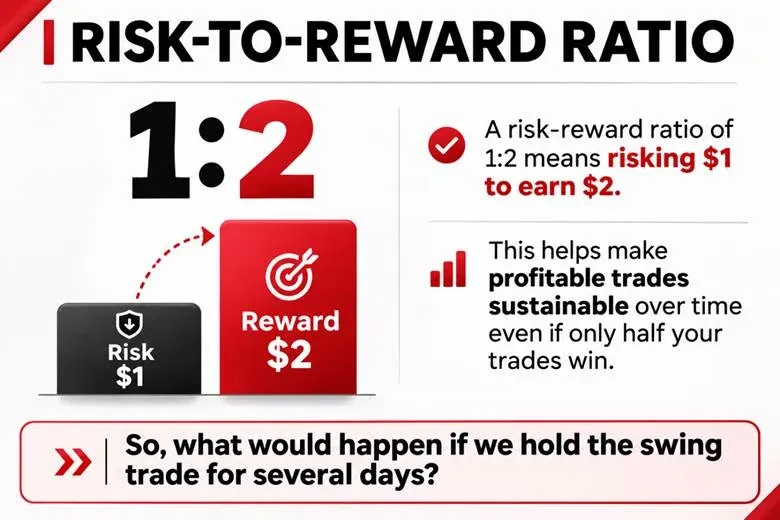
A risk-reward ratio of 1:2 means risking $1 to earn $2, making profitable trades sustainable over time even if only half your trades win. So, what would happen if we hold the swing trade for several days? Say our entry is 1.0800, stop-loss is 1.0700 (100 pips), and take-profit is 1.1000 (200 pips)
Swing trade held several days:
- Position size: 0.08 lots
- Pip value: AED 36.73 × 0.08 = AED 2.94 per pip
- Worst-case loss: 100 × 2.94 = AED 294.00
- Best-case profit: 200 × 2.94 = AED 588.00
For multi-day holds, consider overnight swap costs. Swaps are calculations based on interest rate differentials between currencies.
Swaps can result in either credits or debits, depending on interest rates - you might earn a small credit or pay a charge each night the position stays open. On EUR/USD, negative swaps can run roughly USD 5–10 per standard lot per night, so for 0.08 lots, that is only about AED 1.50–3.00 per night.
Putting It All Together: A Quick 4-Step Pre-Trade Checklist for UAE Traders
UAE traders with Islamic (swap-free) accounts may have alternative fee structures. Always check with your forex broker. On TradeQuo, you can input stop-loss and take-profit levels directly in the order ticket.
The platform will display expected P/L in your account currency. Use this to cross-check your manual estimate before executing the trade. Here is a concise checklist that UAE traders can run through in under one minute before each trade:
- Pip value - Confirm the AED value of one pip for your chosen pair and lot size.
- Position size - Decide your risk percentage, set your stop-loss distance, and calculate the lot size that keeps your AED risk within tolerance.
- Margin check - Verify that the required margin leaves enough free margin for your account to breathe during normal market moves.
- P/L projection - Compute worst-case loss and potential profit in AED, confirm the risk-to-reward ratio meets your minimum (ideally 1:2 or better).
Integrated example using all four steps on EUR/USD, AED 20,000 account:
Pip value (0.18 lots) = AED 6.61 per pip → risk at 30-pip stop = AED 198.30 (≈1% of account) → margin required at 1:30 leverage ≈ AED 2,378 → free margin = AED 17,622 → projected best-case at 60-pip TP = AED 396.60, giving a 1:2 risk-to-reward ratio. This routine reduces the risk of losing funds on impulsive trades, supports disciplined trading strategies, and improves consistency, whether your trading style is scalping, day trading, or position trading. Expectancy is calculated by comparing profits and losses across many trades.
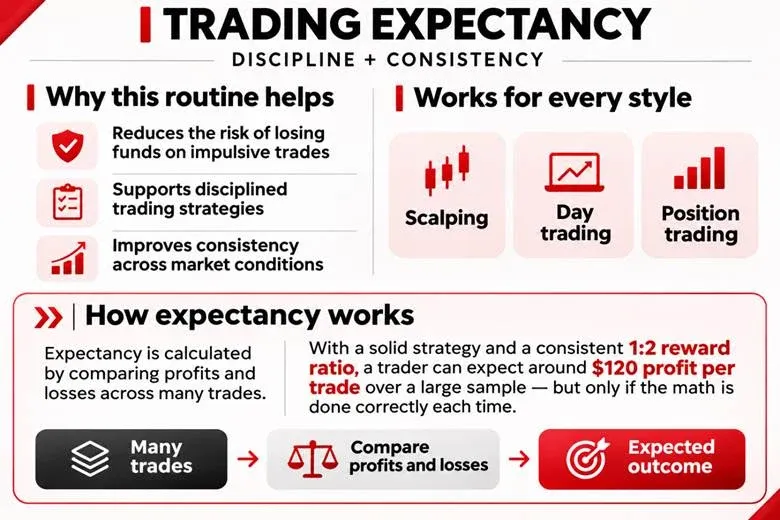
With a solid strategy and consistent 1:2 reward ratio, a trader can expect around $120 profit per trade over a large sample - but only if the math is done correctly each time. Knowing these numbers is as important as any technical analysis or fundamental analysis when trading in the fast-moving financial market. Before risking real AED capital, use a TradeQuo MT5 demo account.
Using a demo account helps traders practice strategies without real funds. You will trade with virtual funds in real market conditions, testing different risk levels, lot sizes, and margin scenarios without any risk. For your demo account pick a popular pair like EUR/USD.
How to Practise These Calculations Safely on TradeQuo's MT5
Choose a hypothetical entry and define stop-loss and take-profit levels. Manually compute all four values (pip value, position size, margin, P/L). Compare your numbers to the values shown on the trading platform.
Experiment with different leverage settings and position sizes to see how quickly margin usage and potential profit change during high market volatility. Effective risk management requires repetition to become second nature. Keep a brief calculation journal.
Record a few sample trades per week - date, pair, pip value, position size, margin, expected P/L - to build confidence before going live. This journal doubles as a log for developing effective strategies and refining your forex strategy over time. When you start trading live, you will already have the muscle memory to run these numbers without hesitation.
FAQ
How often should I redo these calculations if I am swing trading or position trading?
Calculations must be done before every new trade, even if you use similar setups repeatedly. Your account balance changes after each closed trade, leverage use shifts with open positions, and stop-loss distance varies with market analysis and market sentiment. Frequent trading without recalculating is a fast path to the risk of losing funds
Can I rely on platform calculators instead of learning the math?
While MT5 and similar platforms can automate many numbers, understanding the logic helps you avoid accidental over-leverage and spot input errors. The recommended approach: perform a quick manual estimate, then confirm pip value, margin, and P/L on the TradeQuo MT5 order ticket. For multi-day swing trading, recheck margin and free margin periodically, especially before major economic news events that could spike market volatility.
How do fundamental analysis and market news affect these calculations?
Fundamental analysis - covering central bank policies, interest rate decisions, employment reports, or oil-related news affecting GCC economies - does not change the formulas. What it does change is how wide your stop-losses should be and how much market risk to expect. Foreign exchange trading rewards those who prepare, and low transaction costs mean nothing if you lose capital to poor sizing.